
Before screens had answers, hearts did.
I don’t usually read WhatsApp forwards.
Most of them begin with “Must Read!” — which, to me, is reason enough not to.
But one particular forward last week caught my attention.
It was about a teacher.
Maybe it was the word teacher that stopped me.
Or maybe it was because, after all these years, that word still tugs at something in me that hasn’t quite healed.
It was written by a real teacher — one of those rare creatures who actually exist outside the motivational WhatsApp universe. She poured her heart out about how irrelevant she had begun to feel in the eyes of her students. Her classroom, she said, now had more screens than eyes looking back at her.
“They look at me politely,” she wrote, “like a friendly museum exhibit. ‘Miss, that’s not what ChatGPT says.’”
That line made me laugh out loud — and wince a little.
Somewhere between her exasperation and humour, I could sense her heartbreak.
She wasn’t angry that she wasn’t needed anymore.
She was sad that she wasn’t felt anymore.
And that’s when my thoughts drifted to my mother.
She too was a teacher — in Calcutta — long before teachers had to compete with algorithms. Back then, the classroom smelled of chalk and ambition, and the only “cloud” we knew was the one that decided whether school would close early for rain.
“Cut and paste” meant actual scissors and glue.
And “chatbots” were simply what parents called the most talkative child in class.
And yes, I was her student.
For those early years, I was the model child — neat handwriting, punctual homework, almost annoyingly well-behaved. You’d think I was preparing for sainthood.
But in hindsight, that had less to do with brilliance and more with the sheer terror of disappointing the woman who could read my thoughts before I did.
Then, in the fifth standard, she passed away.
And just like that, the front-bencher vanished.
Without her, school turned into foreign territory. My textbooks looked like strangers. I began to drift toward the back benches — the Bermuda Triangle of lost concentration — and stayed there for the rest of my academic life.
Homework became optional.
Discipline became a memory.
If medals were awarded for creative excuses, I’d have won gold every year.
Once, my class teacher wrote on my report card: “Shows potential but is distracted.”
She had no idea the distraction was grief wearing a mischievous grin.
Years later, I happened to meet one of my mother’s former students — then a Company Secretary in a large company.
Tie, title, and all.
The moment he realised I was his teacher’s son, the corporate polish disappeared. He suddenly turned into a boy again.
His eyes softened. His tone changed. He spoke of my mother with such affection that I could almost see her standing there — sari slightly crumpled, chalk dust on her fingers, kindness in her eyes.
He spoke of how she made him feel seen and capable when he doubted himself.
And for a few minutes, the corner of that swanky office turned into a small Calcutta classroom.
It struck me how strange and beautiful that was — that a teacher’s influence can outlive her, travel through decades, and show up unexpectedly in a grown man’s voice.
Sometimes I imagine what it would be like if she were alive and teaching today.
If some bright student told her, “We don’t really need teachers anymore, Miss — ChatGPT explains everything,” she’d probably smile that knowing smile of hers and reply,
“Well, dear, even ChatGPT needed a teacher once. It just doesn’t remember her name.”
Because that’s who she was — witty, warm, and quietly proud of her purpose.
Teaching wasn’t her job; it was her heartbeat.
It gave her wings in India’s biggest city back then — Calcutta — far from her small hometown in Kerala, at a time when independence was not a woman’s default setting.
When I think of her now, I realise she didn’t just teach me alphabets and arithmetic — she taught me how to stand tall, how to care, and how to listen.
And even though I went from being her star student to the class clown, the lessons she left behind somehow survived the chaos.
They show up in unexpected moments — in words, in kindness, in stories like this.
And speaking of stories and lessons that live beyond the classroom — one such story is finding its way into print soon.
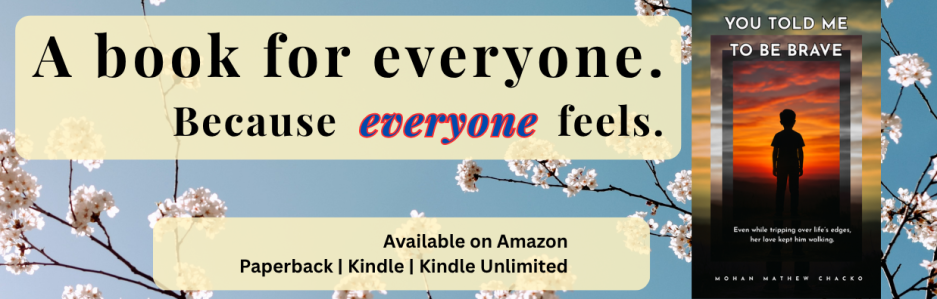
My upcoming memoir, You Told Me To Be Brave, is filled with people who taught, loved, and lived with an authenticity no AI can replicate — not the kind of lessons found in textbooks, but the ones that stay in your bones.
Because in a world run by algorithms and answers, it’s still the human touch — the trembling, imperfect, deeply emotional kind — that teaches us what truly matters.


 WORDSOUPS
In a world overflowing with instant answers, your words show us what truly matters — the warmth of human connection and the quiet influence of those who teach with heart. The story of your mother beautifully captures how real education lives on in the way we make others feel, not in what we make them memorise. Thank you for expressing so beautifully that while AI can explain, only love can truly teach. ❤️
LikeLiked by 2 people
You’ve put into words exactly what I hoped the story would convey — that the deepest lessons aren’t taught, they’re felt. I’m so glad it resonated with you.🙏🏻
LikeLiked by 2 people
👏🌷
LikeLike
My son teaches in Detroit. He says one of the biggest issues is that children really don’t have much of an attention span. Probably related to all those screens.
LikeLike
That’s so true, and it’s a challenge so many educators are facing everywhere now. The constant stimulation from screens has rewired how young minds engage with focus and boredom alike. Your son must have incredible patience. Teaching in today’s environment takes both courage and creativity.🙏🏻
LikeLiked by 1 person
Beautiful post MMC2. A WhatsApp message took you to the childhood memories and that too of your mother who was a real teacher. Even today when we remember those real teachers our eyes sparkle with fond memories. Nice memories and engaging write up. Thanks for sharing 😊
LikeLiked by 1 person
Yes, that little WhatsApp message unexpectedly opened a whole window to a time when teachers weren’t just educators but quiet architects of who we became.
Thank you so much for your kind words! 😊 It truly means a lot.🙏🏻
LikeLiked by 1 person