
How Darkness Teaches Us to Wait for a Softer Light
They call it the night shift.
Those hours when the world sleeps and only endurance stays awake.
But life has its own night shifts too.
They begin quietly, without a roster or warning.
One day is ordinary.
The next, something breaks.
And suddenly, you are working nights inside your own heart.
After bad things happen to us, something in us switches shifts.
We dim the lights, lower expectations, speak softly to ourselves.
Not because we are weak.
But because full brightness would burn us alive.
That darkness is not cruelty.
It is survival.
When my mother fell ill, I was a boy who still believed daylight was permanent.
Hospitals were distant worlds.
And “far away” felt farther than geography.
Her absence turned my days into long corridors of waiting,
lit by hope that flickered like faulty bulbs.
When she finally came home,
everyone said the night was over.
But I knew.
Even then.
She was back, yet not fully returned.
Her body had survived, but something essential had stayed behind in those sterile rooms.
What I thought was dawn
was only a paler version of night.
A lighter shade of dark.
That, too, was a night shift.
Learning that recovery doesn’t always mean restoration.
That presence doesn’t always mean wholeness.
That relief can coexist with grief.
And then she died.
There are nights after such losses
that don’t end with sunrise.
They stretch.
They settle into the bones.
They teach you how to function with shadows as companions.
Years pass.
Decades, even.
One day, without ceremony, you notice something strange.
You are no longer straining to see.
The darkness hasn’t vanished.
But it has softened.
It no longer presses its weight against your chest.
The night hasn’t disappeared.
It has shifted.
And that is when you understand the true gift of grief endured well.
Not forgetting.
Not erasing pain.
But learning to live in a light that does not demand denial.
Now, when I look back,
I see that my mother gave me more than memories.
She gave me the ability to survive my own darkness
until it learned how to become day.
That is her blessing.
The night shift taught me how to endure.
The day shift taught me how to forgive time.
And somewhere between the two,
life… quietly, patiently…
found its way back to the light.
Author’s Note
Time has a quiet way of changing shifts.
What once felt like endless night now rests softly in memory.
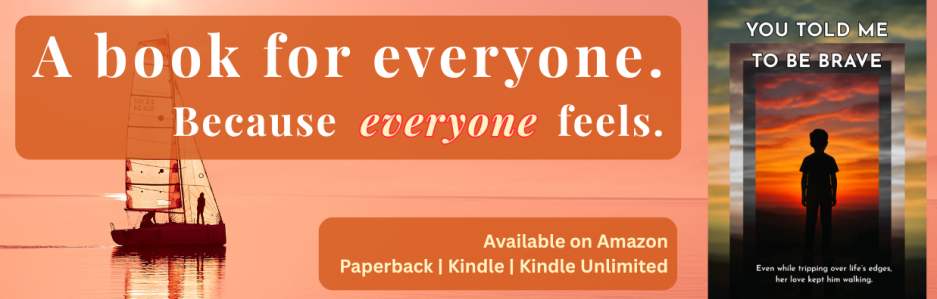
Stories like this eventually found their way into my memoir, You Told Me to Be Brave.
Available worldwide.
— Mohan Mathew Chacko

 WORDSOUPS
Your reflection beautifully captures how grief and hardship don’t simply vanish with time but slowly transform. I especially appreciate the image of the “night shift” — that quiet, heavy stretch where we endure more than we understand. The way you describe the gradual softening of darkness into a gentler light feels very true to lived experience. Healing is rarely dramatic; it is often subtle, almost unnoticed, until one day we realise the weight has shifted.
Thank you for expressing so tenderly that moving into “day” doesn’t mean forgetting the night, but learning to live with it in a new way.
LikeLiked by 3 people
Thank you so much for reading it so closely and generously.🙏🏻
We don’t wake up one morning healed. We simply realise, at some point, that the weight sits differently.
The night doesn’t disappear. It just loosens its hold.🙏🏻💛
LikeLiked by 2 people
Thank you for that beautiful response. 🙏🏻
“The weight sits differently” — that line stays with me. There is such quiet wisdom in recognising that healing is not the erasing of what was, but a gentle repositioning of it within us. The night may not disappear, as you say, but when it loosens its hold, we begin to breathe more freely again.
Your words carry a calm reassurance — that transformation doesn’t have to be dramatic to be real. Sometimes it is simply the grace of discovering we are no longer held as tightly by what once overwhelmed us.
Grateful for this exchange. 💛
LikeLiked by 2 people
🙏🏻💛
LikeLiked by 2 people
Very beautiful description about grief and trauma and how it shapes you and how you survive it. I grew up very ill, since early childhood, never knowing if I’d survive to the next day. The nights were the worst. And starting at age six, a close relative or family member died every six years. So I lost my innocence very young. But then I invented rose colored glasses and held on to them fiercely, until the trauma was too big to keep them in place anymore.You’ve described those feelings so perfectly. I’m sorry you lost your Mom when you were young and thankful you survived and learned to thrive and share that with others.
LikeLiked by 3 people
Thank you for sharing something so deeply personal. 🙏🏻💛 Reading your words, I can almost feel those long nights you speak of. Growing up with that kind of uncertainty changes a person in ways that are hard to explain to anyone who hasn’t lived it.
Your image of the rose-coloured glasses moved me. Sometimes they are not denial. They are protection.
I’m sorry for the losses you’ve carried, and I deeply respect the resilience it must have taken to keep going through them. The fact that you can articulate it the way you just did tells me those nights did not defeat you. 🙏🏻
LikeLiked by 1 person